By Line Storgaard-Conley and Stacey Piper
It’s back-to-school month for the Piper family, and this year we’re navigating the world of high school. We’ve already tackled appropriate cell phone, internet, and social media usage with our freshman, but we now need to navigate the responsible use of artificial intelligence (AI) too. School policies and curricula focus on embracing technology as an academic support tool and provide guidance on how AI chatbots like ChatGPT, Google Gemini, and Microsoft CoPilot can enhance student learning.
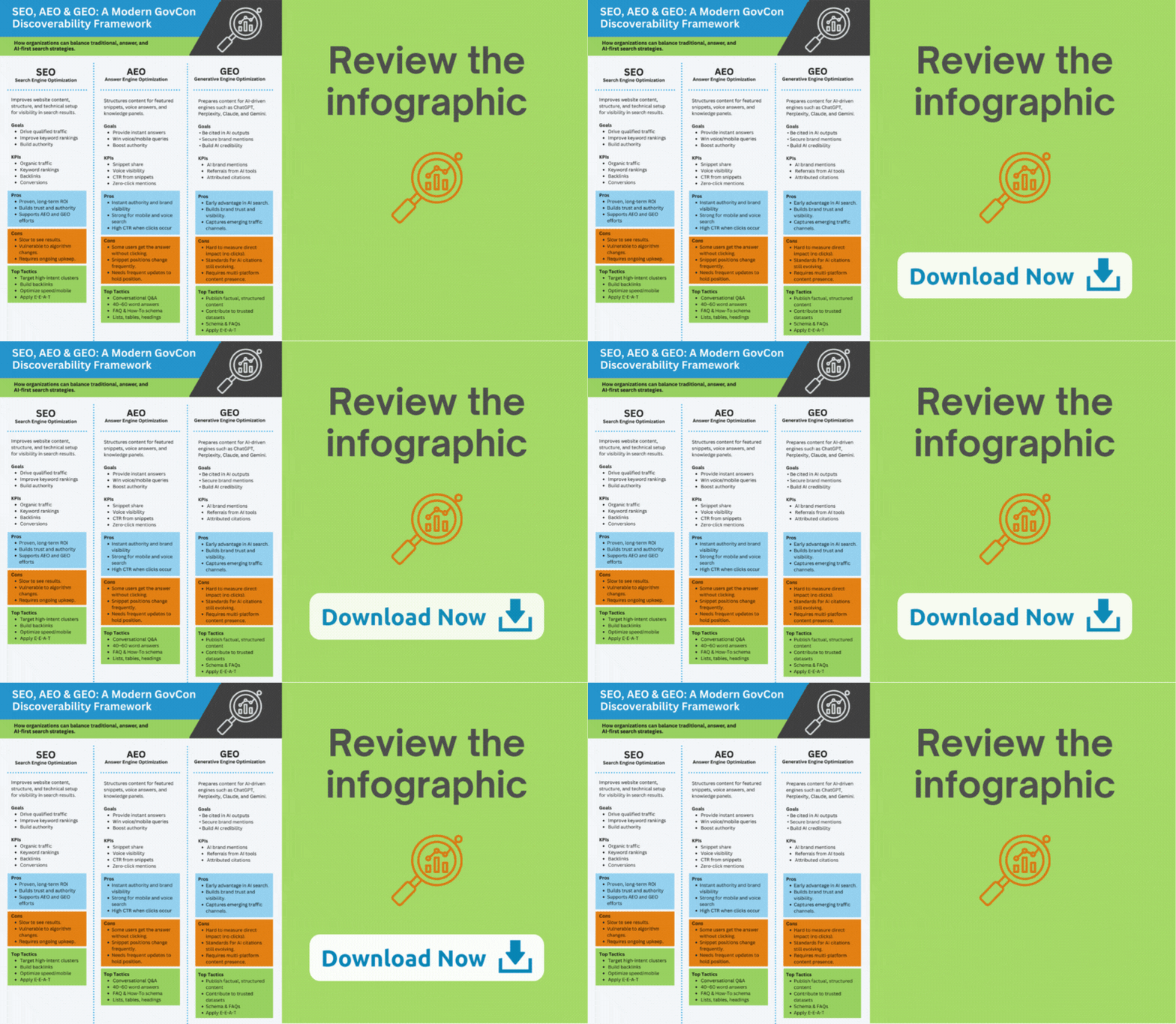
As AI becomes a part of daily life, embedded into both voice and search assistants, AI literacy is essential for all of us, including our world of U.S. government contracting (GovCon). You’re already familiar with the power of search engine optimization (SEO), but now organizations that want to remain visible in the rapidly evolving digital search landscape must optimize not just for traditional search engines but also for answer-driven engines (AEO) and AI-powered generative engines (GEO). Each layer of discoverability plays a different role: SEO builds the foundation, AEO secures instant visibility in snippets and voice search, and GEO future-proofs your brand for AI-driven results.
For GovCon organizations, success requires an integrated approach to search engine marketing (SEM) that balances SEO, AEO, and GEO. But it’s not just about balance—it’s about standing out. Those who move early on AEO and GEO will be among the first to show up in AI-driven results and geographic search, gaining visibility before competitors catch up. In a crowded federal marketplace, being one of the first to master these new search frontiers can set your organization apart.
Search Engine Optimization (SEO)
Definition: SEO improves a website’s content, structure, and technical setup to increase visibility in search results. By aligning with search algorithms and user intent, SEO drives sustainable, non-paid traffic and builds long-term credibility.
Primary Goals
• Drive qualified traffic.
• Improve rankings for targeted keywords.
• Build brand authority and trust.
How It Works
• Target high-intent keyword clusters.
• Build authoritative backlinks and internal links.
• Optimize site speed, mobile usability, and structured data.
• Reinforce expertise, experience, authority, and trust (E-E-A-T).
GovCon Use Cases
• Ranking a GSA Schedule 70 overview page for procurement officers.
• Creating a DoD market research portal.
• Publishing annual federal spending trend reports.
KPIs
• Organic traffic growth.
• Keyword rankings.
• Backlink acquisition.
• Conversions from organic sessions.
Pros & Cons
✅ Proven ROI and brand authority.
❌ Slower results; ongoing upkeep; vulnerable to algorithm changes.
Ranking Tips
Run quarterly content refreshes, regular technical audits, and structured schema updates.
Answer Engine Optimization (AEO)
Definition: AEO structures content so it appears in featured snippets, “People Also Ask” results, knowledge panels, and voice search answers. The goal is to capture position zero with concise, authoritative responses.
Primary Goals
- Provide instant, trusted answers.
- Win visibility in voice assistant and mobile queries.
- Enhance brand authority even without clicks.
How It Works
- Write conversational Q&A content that matches voice search phrasing.
- Deliver direct answers in 40–60 words.
- Apply FAQ and How-To schema for structured data.
- Format content with headings, lists, and tables.
- Reinforce content credibility with E-E-A-T (expertise, experience, authority, and trust).
GovCon Use Cases
- “Top 10 Questions About GSA Schedules” FAQ pages.
- FedRAMP compliance checklists.
- Plain-language guides to RFP submissions.
KPIs
- Featured snippet share.
- Voice search visibility.
- CTR from snippet listings.
- Brand mentions in zero-click responses.
Pros & Cons
✅ Instant authority, mobile-first advantage, and higher CTR when clicks
Ranking Tips
Target “People Also Ask” queries, refresh FAQs regularly, and monitor snippet positioning weekly.
Generative Engine Optimization (GEO)
Definition: GEO prepares content for AI-driven engines like ChatGPT, Perplexity, and Google Gemini. The objective is to ensure your brand and information are accurately cited, summarized, and trusted in AI-generated answers.
Primary Goals
- Be the authoritative source referenced in AI results.
- Ensure consistent brand mentions in AI-generated outputs.
- Build credibility in the AI search ecosystem.
How It Works
- Publish factual, verifiable, and structured content with citations.
- Contribute to trusted sources that AI models rely on (government reports, SAM.gov, GAO studies, Wikipedia).
- Use schema, FAQs, and tables to make parsing easier.
- Apply E-E-A-T principles consistently.
GovCon Use Cases
- Cybersecurity compliance summaries for contractors.
- Budget forecasts AI can cite.
- DoD procurement timelines simplified for Q&A tools.
KPIs
- Brand mentions and citation shares in AI responses.
- Referral traffic from AI tools (e.g., Perplexity, Microsoft CoPilot).
- Number of attributed AI citations.
Pros & Cons
✅ Early advantage, builds trust, and captures emerging traffic streams.
❌ Hard to measure; citation standards still evolving; risk of misattribution to competitors.
Ranking Tips
Publish authoritative guides, contribute to credible datasets, and use structured data for easy AI extraction.
The Vulnerabilities Behind SEO, AEO, and GEO
While SEO, AEO, and GEO each offer powerful opportunities to increase visibility, they also carry unique risks. From shifting algorithms and content decay to changing AI answer box standards and potential misattribution in generative engines, brands must be prepared for disruption. Recognizing these challenges upfront and building a diversified strategy helps reduce exposure, protect visibility, and sustain long-term results.
- SEO: Algorithm volatility, content decay, and slow ROI.
- AEO: Snippet loss or sudden drops in answer box visibility.
- GEO: Misattribution risk—AI may reference competitors instead; evolving standards for attribution.
Building a diversified approach minimizes these risks.
What’s Next: Preparing for AI-First Search
Traditional search traffic may decline 25% by 2026 (Gartner), while Google still commands nearly 90% of all searches and is rolling out AI Overviews in 13% of results (Semrush). To adapt, organizations must:
- Diversify: Balance SEO, AEO, and GEO instead of relying on one channel.
- Publish fact-based content: Prioritize clarity, accuracy, and authoritative sourcing.
- Invest in trusted ecosystems: Get cited in government datasets, authoritative publications, and Wikipedia.
- Track new KPIs: Measure AI-driven citations, brand mentions, and emerging platform traffic.
- Future-proof content: Implement structured data, reinforce E-E-A-T, and use Q&A formatting for both human and AI parsing.
Back-to-school season isn’t just for kids. For govcon professionals, it’s a perfect time to hit the books and get educated on the new ABCs of digital visibility: SEO, AEO, and GEO.
Think of them as three complementary pillars of your learning curriculum. SEO builds your foundational knowledge and long-term authority, much like mastering a core subject. AEO is about getting the direct answers—securing instant credibility when someone asks a specific question. GEO is your ticket to the future, ensuring you’re prepared for the next wave of AI-driven platforms.
The organizations that will graduate with honors are those that start their studies now. Strengthen your SEO foundations, expand your curriculum with AEO, and make an early investment in GEO to get a first-mover advantage. This isn’t just about homework; it’s about leading the class in the evolving world of government contracting.
Want to strengthen your visibility in search engines? Contact me to review your content marketing strategies.